
Harper Albrecht · 4 September 2026
Investigating the Cultural Significance of Carved Motifs in Traditional Furniture from Isolated Forest Communities
Researchers have spent decades examining how carved motifs on furniture from remote forest communities carry layers of meaning that connect daily life with ancestral stories, spiritual beliefs, and environmental knowledge. These patterns appear on chairs, tables, chests, and stools crafted by groups living in places like the dense woodlands of Borneo, the Pacific Northwest, and parts of the Amazon basin, where isolation has helped preserve techniques passed down through generations.
Studies from the early 2000s onward show that artisans select motifs based on local flora and fauna, turning ordinary household items into records of community identity. Data collected by field anthropologists indicates that geometric shapes often represent rivers or mountain ridges while animal figures stand for clan lineages or seasonal hunting cycles. Such designs do more than decorate, they encode practical information about sustainable resource use that outsiders might overlook at first glance.
Historical Development of Motif Traditions
Archaeological evidence places the earliest known examples of these carved furnishings several centuries back, with pieces recovered from abandoned settlements showing consistent use of interlocking vine patterns and stylized bird forms. Oral histories recorded in teh 1980s reveal that carvers once trained for years under elders who taught both the physical carving strokes and the symbolic weight each line carried. Migration patterns during the mid-20th century brought some communities into closer contact with outside markets, yet many continued to reserve the most intricate work for internal use only.
By the 2010s, international exhibitions began featuring select pieces, prompting renewed interest among younger community members who saw economic potential without abandoning core meanings. One study conducted across multiple sites found that communities maintaining strict rules about motif ownership experienced stronger cultural continuity compared with those where designs entered commercial trade more freely.
Regional Variations and Symbolic Systems
Communities in Southeast Asian rainforests frequently employ motifs based on hornbills and orchids, whereas groups farther north favor raven and cedar imagery that reflects different ecosystems. Researchers note that the same basic spiral can signify protection in one area and fertility in another, depending on accompanying oral explanations. Furniture made for ceremonies carries denser arrangements of symbols than everyday seating, a distinction documented through comparative inventories compiled by museum teams in Canada and Indonesia.
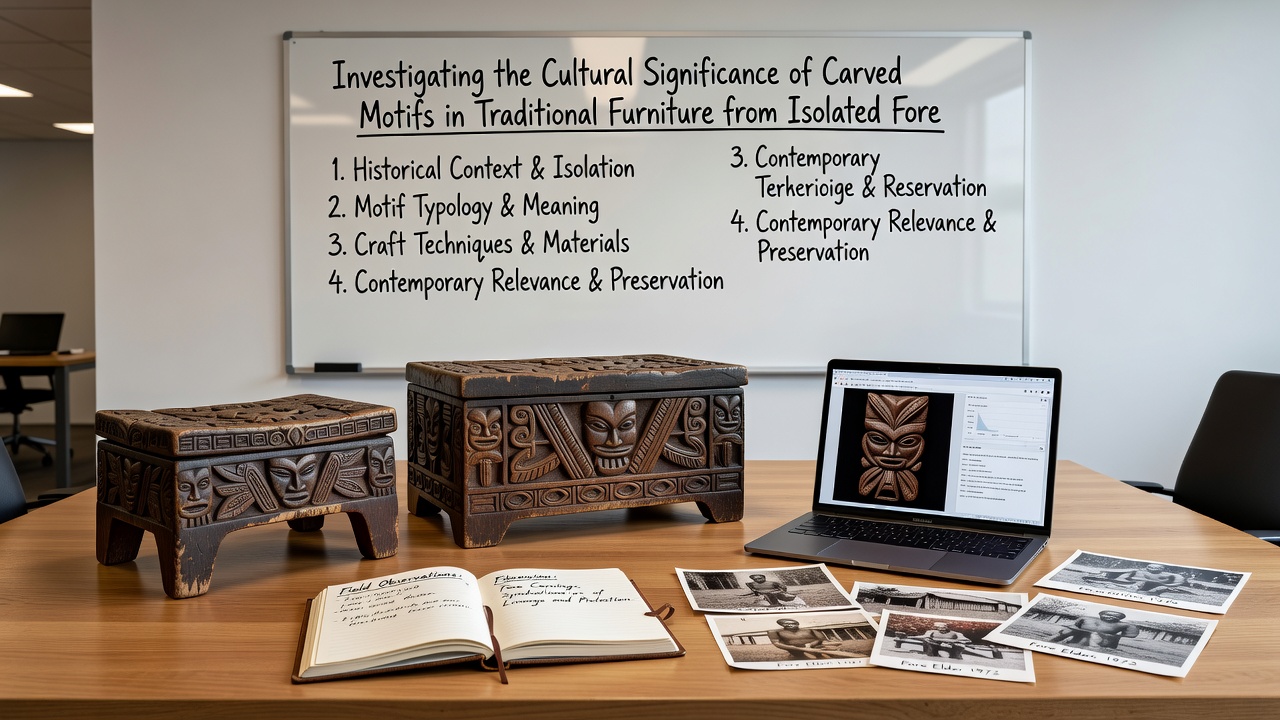
What's interesting is how these regional systems interact when neighboring groups trade or intermarry. Shared motifs sometimes emerge with altered interpretations, creating hybrid forms that still respect original boundaries. Field notes from recent expeditions highlight cases where a single chest displayed both local river symbols and borrowed mountain icons, reflecting blended family histories rather than loss of tradition.
Contemporary Research Approaches and Findings
Modern investigators combine ethnographic interviews with laser scanning and material analysis to map how carving depth and tool marks correlate with specific cultural messages. A 2024 report issued by the UNESCO Intangible Cultural Heritage programme catalogued over two hundred distinct motif families across isolated forest sites, emphasizing their role in transmitting ecological knowledge during periods of environmental change. Additional work from the University of British Columbia's Indigenous Studies department, published in early 2025, tracked how digital documentation projects help communities archive designs while retaining control over access.
In September 2026 several research teams plan coordinated fieldwork in three continents to compare motif evolution under increasing tourism pressure. Preliminary data already suggests that communities enforcing apprenticeship requirements continue producing furniture with full symbolic range, while those shifting toward faster production see simplification of patterns. Observers note that collaborative mapping tools developed by these groups allow real-time updates without exposing restricted meanings to external viewers.
Preservation Challenges and Community Responses
Climate shifts and logging activities threaten the hardwood species traditionally used for carving, prompting some artisans to experiment with alternative woods that accept fine detail less readily. At the same time, younger carvers experiment with new tools while insisting on learning the older stories first. Government programs in Australia and Brazil have begun offering grants tied to cultural documentation rather than output volume, a shift welcomed by community leaders who prioritize meaning over quantity.
Take one village in the interior highlands where elders and youth worked together to photograph every surviving piece of furniture before it left the area. The resulting archive now serves as both teaching resource and legal reference when disputes arise over design ownership. Similar efforts elsewhere demonstrate that documentation succeeds best when communities lead the process and decide which elements remain private.
Conclusion
Evidence gathered across decades shows that carved motifs on traditional furniture from isolated forest communities function as living archives of cultural knowledge, environmental awareness, and social structure. Continued research through 2026 and beyond will likely reveal further connections between these designs and community resilience. The ball remains in the hands of the artisans themselves, who continue deciding how much of their symbolic language travels outward while safeguarding what stays within.