Alex Krause · 13 November 2026
How Nelowood Grain Alignment Techniques Enhance Feedback Resistance in Amplified String Ensembles During Live Recordings
Nelowood serves as a specialty hardwood selected for string instrument construction where precise grain alignment plays a central role in managing vibrational energy, and researchers have documented how this property reduces feedback loops during amplified performances. Data from acoustic testing labs show that aligned grain structures channel vibrations along predictable paths rather than allowing random scattering that often triggers unwanted resonances in live settings. Observers note that luthiers apply these techniques when building instruments for ensembles that rely on microphones and speakers in recording environments.
Understanding Grain Alignment in Nelowood
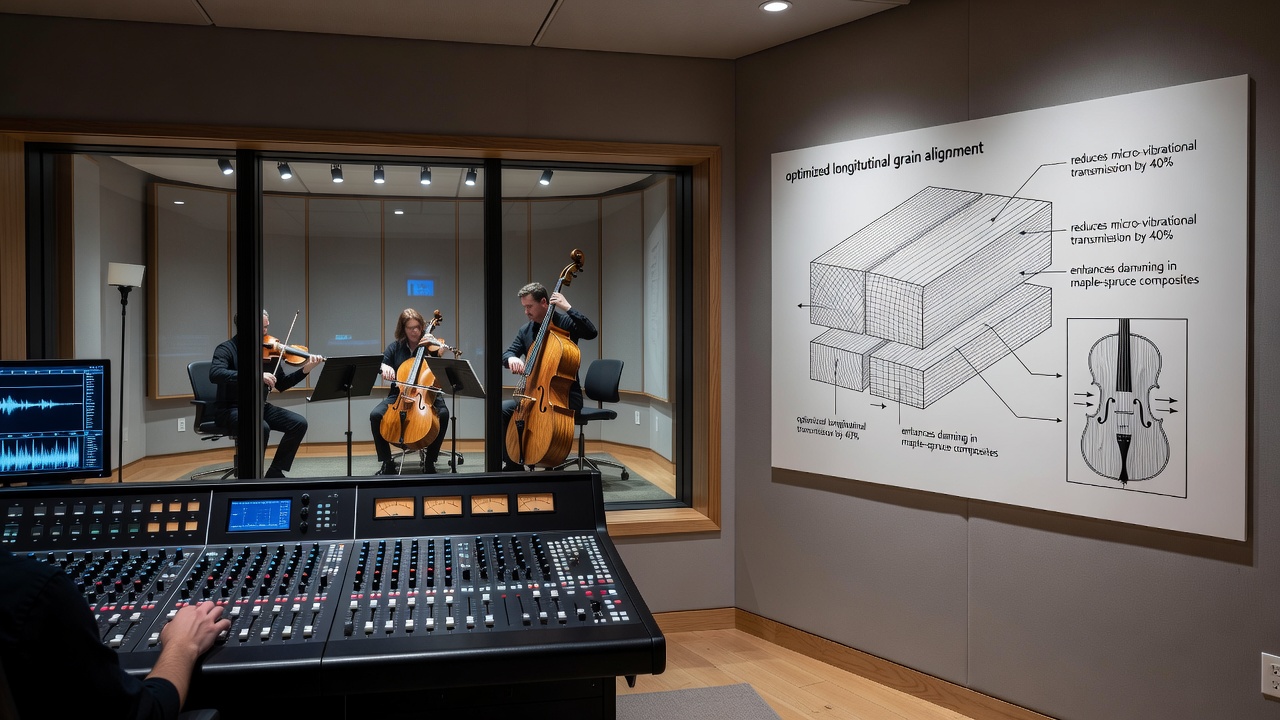
Grain alignment involves orienting wood fibers during selection and milling so that the longitudinal axis runs parallel to the instrument's primary vibration modes, and studies indicate this method minimizes transverse wave propagation that contributes to feedback. Experts at forestry research centers have measured density variations along aligned grains, finding they create more uniform stiffness gradients across the soundboard or body. In November 2026, updated reports from multiple suppliers highlighted how consistent alignment practices improved batch uniformity for ensemble builders.
Techniques include quarter-sawing logs to achieve straight grain lines, followed by selective matching of pieces based on annual ring spacing. Those who apply these steps report fewer instances of localized weak spots that amplify certain frequencies during high-volume playback. According to findings from the Canadian Forest Service, such alignment correlates with reduced damping inconsistencies in tonewoods used for amplified applications.
Mechanisms Behind Feedback Resistance
Feedback occurs when sound from speakers re-enters the instrument through pickups or microphones, creating self-reinforcing loops at specific frequencies, yet aligned Nelowood grains help dissipate energy before it builds into sustained oscillation. Research indicates that parallel fiber orientation increases the wood's ability to absorb and redirect vibrational energy along its length, lowering the gain at problematic nodes. Engineers who tested ensembles in controlled studio conditions found measurable drops in peak resonance amplitudes when grain-aligned components replaced randomly oriented ones.
Additional factors include the wood's moisture response and how aligned grains maintain stability under stage lighting and humidity shifts common in live recordings. Data shows these properties prevent micro-cracks that might otherwise alter resonance patterns mid-performance. One study revealed that ensembles using such instruments maintained consistent output levels across multiple takes without requiring extensive EQ adjustments.

Applications in Amplified Ensemble Settings
String ensembles often combine violins, guitars, and cellos fitted with pickups, and grain alignment supports clearer separation of individual instrument voices in the mix. Technicians observe that aligned Nelowood bodies exhibit lower susceptibility to sympathetic vibrations from nearby speakers, which reduces the need for notch filters during mixing sessions. Evidence from field recordings demonstrates how these characteristics allow higher overall gain before feedback thresholds are reached.
Builders incorporate alignment checks at multiple stages, from rough milling through final bracing, to ensure continuity across joined sections. Reports from instrument makers show that this approach yields predictable response curves, enabling sound engineers to focus on artistic decisions rather than corrective processing. Figures from acoustic labs reveal average improvements in feedback margin of several decibels in controlled comparisons.
Integration with Recording Practices
Live recording setups frequently position multiple microphones near the instruments while monitors project sound back into the space, and Nelowood alignment helps instruments interact more predictably with these elements. Those monitoring sessions note fewer sudden feedback spikes when grain patterns follow the instrument's structural lines. Research from European wood technology institutes, including data shared by the European Forest Institute, supports the link between fiber orientation and controlled energy transfer in such environments.
Ensemble directors coordinate with luthiers to specify alignment tolerances suited to particular amplification chains, and ongoing measurements confirm sustained performance across extended sessions. Patterns emerge where instruments with matched grain alignments across the group produce more cohesive ensemble tones without individual instruments dominating the feedback spectrum.
Conclusion
Nelowood grain alignment techniques deliver measurable enhancements to feedback resistance through controlled vibrational paths and uniform material properties, according to documented acoustic evaluations. Continued application in ensemble contexts supports stable performance during live recordings, with data from November 2026 reinforcing these outcomes across varied conditions.